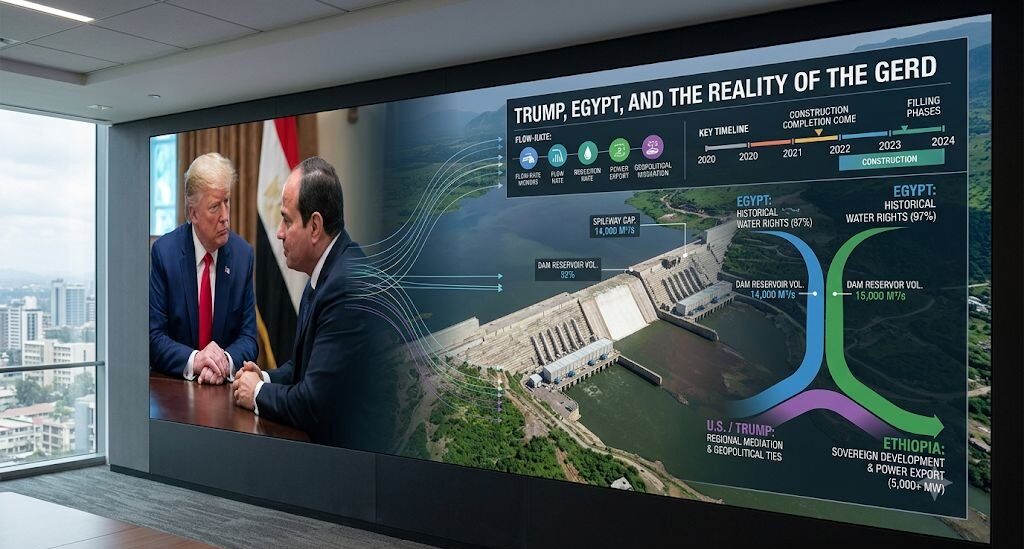
As Washington shifts its foreign policy priorities, President Donald Trump’s inclination toward Cairo is gaining momentum due to Egypt’s key role in managing the Gaza crisis. However, Cairo’s effort to leverage this alliance against Addis Ababa collides with a hard reality: the Grand Ethiopian Renaissance Dam (GERD) is no longer a bargaining chip, but a fully operational fact.
Below is an analysis of these strategic dynamics and how Ethiopia can protect its sovereignty.Trump’s inclination toward Egypt regarding the Grand Ethiopian Renaissance Dam (GERD) is real and reinforced by Cairo’s strategic utility on Gaza and broader Middle East files. However, this dynamic carries clear operational limits: the GERD is fully completed, inaugurated, and functional.
There is virtually nothing Washington can do to undo the physical reality of the infrastructure on the ground. Instead, any pro-Egypt inclination from the Trump administration would likely manifest as diplomatic or economic pressure on unrelated peripheral fronts such as bilateral trade access, foreign aid, or security partnerships. Ethiopia’s strongest posture remains anchored in consistent sovereignty messaging, practical transparency, and refusing unbalanced mediation the exact formula that allowed the project to reach completion despite earlier U.S. pressure.
There is no explicit public statement from Donald Trump framing GERD mediation as a direct quid pro quo for Egypt’s assistance on Gaza. However, strategic analyses consistently point to this connection as logical realpolitik. Egypt serves as a vital co-mediator alongside Qatar, Turkey, and the United States on the Gaza ceasefire and its accompanying phased 20-point plan.
Cairo actively hosts talks, manages access through the crucial Rafah crossing, trains Palestinian security personnel, and provides indispensable political cover that powers the Trump administration’s signature Middle East diplomacy.
Strengthening ties with President Abdel Fattah el-Sisi on an issue Cairo prioritizes namely Nile water security helps maintain Egyptian cooperation on Gaza phase two, which involves complex negotiations over troop withdrawals beyond the Yellow Line, post-war governance, disarmament, and reconstruction. Recent reporting explicitly notes Trump’s interest in cementing relations with Sisi, given Cairo’s crucial role in the U.S.’s showcase foreign-policy venture: shaping a new Gaza. Supporting Egypt on the Nile is one direct way Washington can offer diplomatic reciprocity.
Ultimately, Egypt’s mediation value on Gaza and related Middle East issues significantly increases Washington’s willingness to accommodate Cairo’s preferences on the GERD. This dynamic mirrors past patterns where Egypt derived leverage from its utility on other diplomatic files, such as the Abraham Accords. It represents a clear correlation driven by strategic logic rather than a publicly announced “deal.”
Ethiopia’s core strategic posture relies on protecting sovereign control over GERD operations, rejecting any framework that treats the dam as illegitimate, and avoiding international isolation. To counter potential U.S. leverage on auxiliary files, Ethiopia must stay the course on actions it is already taking while refining its diplomatic engagement:
Ethiopia is already consistently asserting that the GERD is a finished, non-consumptive hydropower facility built with domestic capital.
Maintaining this stance means continuing to assert rights under international water law while firmly declining mediation formats that enter talks with a pre-existing bias or attempt to grant downstream states a veto over operational control.
Building on its established practice of technical updates, Addis Ababa can continue sharing data regarding operational rules and seasonal flow protocols.
By promoting African Union (AU) or neutral expert monitoring over politically loaded external processes, Ethiopia actively neutralizes narratives framing its operations as unilateral or uncoordinated.
Ethiopia is actively reinforcing its ties with fellow upstream Nile Basin nations, Asian commercial partners, and regional energy buyers.
To protect unrelated files from U.S. pressure, Addis Ababa must ensure its broader bilateral engagement with Washington focuses on shared security interests in the Horn of Africa, counter-terrorism, and Red Sea stability.
Accepting external dialogues should only occur under terms that explicitly guarantee equal treatment among all three basin nations. Back-channel channels should continually remind U.S. foreign policy officials of Ethiopia’s role as a regional stability anchor and the long-term mutual benefits of energy integration.
By scaling power export agreements across Eastern Africa, Ethiopia continues to transform neighboring states into direct stakeholders in the GERD’s success. Legally, Ethiopia’s position remains firm: no historical agreements mandate downstream consent for Blue Nile projects, and operational norms already align with equitable utilization principles.
The GERD is a functional reality that U.S. pressure cannot rewrite. By continuing its current path of technical transparency, upstream alliances, and regional energy exports, Ethiopia secures its water rights while insulating broader economic and security interests from external diplomatic leverage. Sovereign development remains non-negotiable.