

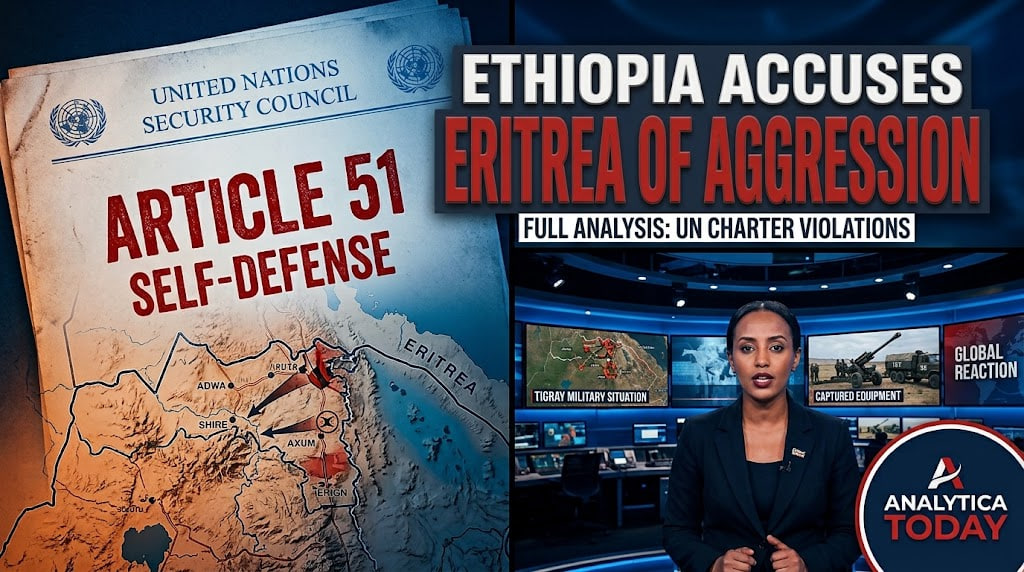
When a government presents seized weapons to foreign diplomats and invokes Article 51 of the United Nations Charter, it is doing more than communicating a security concern. It is defining the legal and diplomatic terms of a confrontation. Ethiopia’s latest actions against Eritrea place territorial sovereignty, the right to self-defence and the responsibility of the international community at the centre of the unfolding crisis in the Horn of Africa. On 9 October 2026, Ethiopian Foreign Minister Gedion Timothewos informed the United Nations Security Council that Ethiopia was exercising its inherent right of self-defense under Article 51. Addis Ababa accused Eritrea of deploying infantry and mechanized units into Ethiopian territory, advancing deep into Tigray, and supporting armed groups operating against the federal government. Reports also indicate that Ethiopian authorities have displayed seized weapons of Eritrean origin to foreign diplomats in Addis Ababa.
Article 51 recognizes the inherent right of individual or collective self-defense when an armed attack occurs against a United Nations member state. Ethiopia’s invocation places its response within an established framework of international law. Its position is that defending its territory against foreign military intervention is a sovereign right, not an act of aggression. The distinction matters because a state does not surrender its right to protect its population and territorial integrity simply because its neighbor disputes its account of events. Ethiopia’s notification to the Security Council also establishes a formal record of its position and places the international community on notice of the security situation along its northern frontier.
The reported presentation of seized weapons to diplomats in Addis Ababa adds a practical dimension to Ethiopia’s diplomatic campaign. Physical military equipment makes the confrontation more tangible for foreign representatives and connects Ethiopia’s accusations to the immediate security situation.
For Addis Ababa, the objective is to demonstrate that the dispute concerns national security and territorial integrity, not simply deteriorating relations between neighboring governments. The presentation also gives diplomats an opportunity to examine the material and understand Ethiopia’s concerns directly.
The wider significance lies in the relationship between military developments and diplomacy. By combining its Article 51 notification with direct engagement with foreign missions, Ethiopia is seeking international understanding for its security position while establishing the basis for a coordinated diplomatic response.
Developments on the ground make this diplomatic effort particularly urgent. Fighting intensified in September after a coalition of armed groups led by the Tigray People’s Liberation Front launched attacks against federal forces. The conflict has reopened one of Ethiopia’s most sensitive security theatres, where the consequences of the 2020–2022 war remain deeply embedded.
Ethiopian government forces subsequently regained several towns, including Zalambessa, near the Eritrean border, by 13 October. The government’s military operations and its claim of self-defence must be understood within this wider confrontation, where internal armed opposition and interstate tensions increasingly intersect.
For Ethiopia, the central strategic concern is that external military involvement could strengthen armed opposition, complicate the restoration of federal authority and expose northern communities to another devastating conflict. The government’s position is that these developments cannot be separated from the defence of national sovereignty.
Eritrea has responded by rejecting Ethiopia’s position and asking the Security Council to take deterrent measures under Chapter VII of the Charter. The competing diplomatic initiatives demonstrate that both governments are attempting to shape international perceptions of the crisis.
Ethiopia’s advantage in this diplomatic contest will depend on maintaining a clear distinction between defending its territory and pursuing broader regional objectives. Article 51 authorises self-defence within legal limits; it does not provide unrestricted authority for military action. Necessity and proportionality remain central to the assessment of any response.
The regional implications extend beyond the two countries. Renewed hostilities could affect the implementation of the Pretoria Agreement, destabilise the northern frontier and complicate relations among states already divided over Red Sea security. Ethiopia’s pursuit of peaceful and secure maritime access remains a separate strategic question and should not be confused with its right to territorial defence.
The immediate priority is to prevent the confrontation from expanding into a prolonged interstate war. Ethiopia can reinforce its position through continued engagement with the Security Council, diplomatic missions and relevant African institutions, while maintaining military discipline and protecting civilians.
International partners should take Ethiopia’s security concerns seriously and support measures that prevent further cross-border escalation. At the same time, the legal framework must remain clear: self-defence protects sovereignty, while diplomacy provides the means to prevent a dangerous confrontation from becoming a regional conflict.
Ethiopia’s invocation of Article 51 marks a significant moment in its confrontation with Eritrea. By placing its right to self-defence before the United Nations and presenting seized weapons to diplomats, Addis Ababa is seeking to establish that the protection of its territory is a matter of international law as well as national security. The ultimate test will be whether Ethiopia can defend its sovereignty while containing the conflict and preserving the possibility of a peaceful regional order.