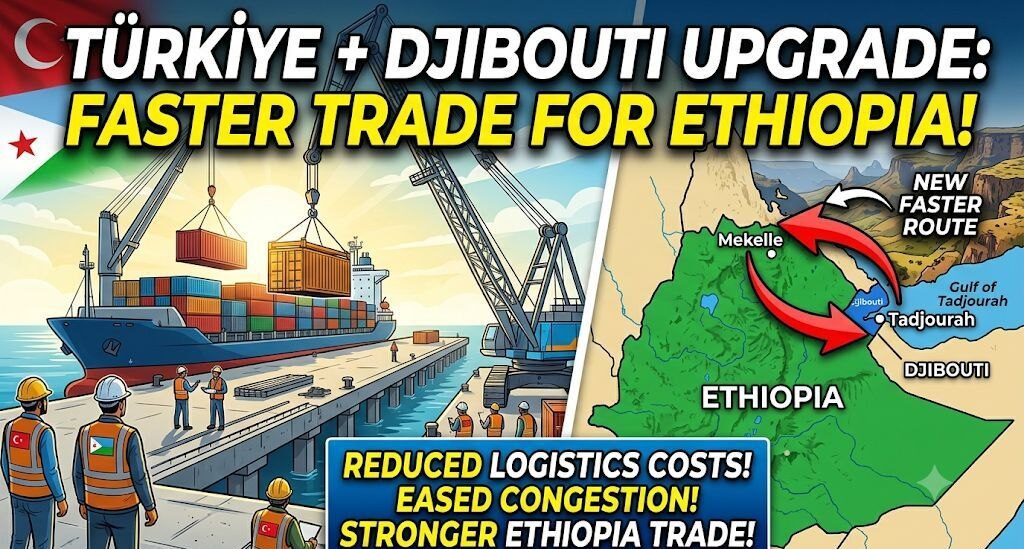
The MoU between Türkiye’s Tiryaki Agro and Djibouti’s Ports and Free Zones Authority to develop the Port of Tadjourah marks a pivotal shift for landlocked Ethiopia. As the nation relies on Djibouti for up to 95% of its trade, modernizing this northern corridor offers a critical alternative. This strategic partnership aims to slash logistics costs, ease main port congestion, and accelerate economic growth across northern Ethiopia.
Ethiopia, as the world’s most populous landlocked country with over 120 million people, depends overwhelmingly on Djibouti for maritime access. Approximately 90% of its international trade imports worth tens of billions annually and key exports like coffee, sesame, livestock, and emerging minerals flows through Djibouti ports. This reliance costs Ethiopia roughly $1.5–2 billion yearly in port fees, logistics, and related expenses, making any enhancement or diversification of these corridors vital for economic efficiency, growth, and national security.
The Port of Tadjourah, located on Djibouti’s northern coast in the Gulf of Tadjoura, was modernized and expanded with a focus on serving Ethiopia. Built at a cost of around $90 million and commissioned around 2017, it was primarily designed to export potash from Ethiopia’s Afar Region (Danakil Depression) and handle general cargo such as grains, livestock, sesame, fertilizers, and other bulk commodities. It features high-capacity loading (up to 2,000 tonnes of potash per hour) and serves as a multipurpose facility. New road links, like RN-11 from Tadjourah to Balho, significantly shorten transit times to northern Ethiopian regions (Afar and potentially Tigray) compared to traditional southern routes via Galafi.
Tadjourah offers a closer gateway for northern Ethiopia than the main Djibouti Port (Doraleh and others), reducing road/rail distances, fuel costs, congestion, and delays.
Tiryaki Agro, a major Turkish agricultural commodities trader and logistics player, signed the recent Memorandum of Understanding to explore modernization, expansion, possible long-term operation/concession, and enhanced agricultural trade/logistics capacity at Tadjourah. The focus includes better infrastructure, storage, handling of bulk/agricultural goods, and positioning Djibouti (and Tadjourah) as a stronger regional hub for the Horn of Africa.
This is not just another operator switch; Tiryaki brings expertise in agricultural supply chains, global markets, and port operations. Their involvement signals potential for efficiency gains, private-sector investment, technology transfer, and integration into broader Turkish-African trade networks.
Ethiopia’s heavy dependence on the main Djibouti port complex creates bottlenecks. Tadjourah’s development provides a viable northern alternative, especially for bulk and agricultural cargo. This could lower transport costs, speed up turnaround times, and improve reliability critical for perishable exports and just-in-time imports.
Ethiopia’s Afar and Tigray regions stand to gain most. Potash mining (a potential major forex earner), agriculture, and livestock can access faster export routes. Planned or discussed rail connections (e.g., standard-gauge lines linking northern Ethiopia to Red Sea ports including Tadjourah) would amplify this.
Shorter corridors mean lower trucking/rail costs, reduced foreign exchange outflow on logistics, and more competitive Ethiopian exports on global markets. Even marginal improvements could
save hundreds of millions annually as trade volumes grow.
Turkish involvement may attract more FDI, skills, and connections. It aligns with Ethiopia’s ambitions for industrial parks, agro-processing, and export-led growth. Enhanced port capacity supports Vision 2030-style goals and integration into African Continental Free Trade Area (AfCFTA) dynamics.
While promising, outcomes depend on implementation. Key issues include:
Actual investment levels and timelines post-MoU. Integration with Ethiopian infrastructure (roads, rail, dry ports).
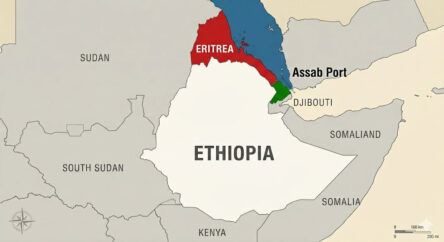
Geopolitical dynamics in the Horn (Red Sea tensions, relations with Eritrea, Somalia).
Environmental and community impacts in Tadjourah and Ethiopian border areas.
Previous operators like Saudi RSGT’s 30-year concession efforts highlight that execution matters more than agreements.
This MoU reinforces Djibouti’s role as Ethiopia’s primary gateway while modernizing secondary ports. For Ethiopia, it represents incremental progress toward more resilient trade logistics without needing new coastal sovereignty. In a region prone to volatility, reliable, multi-port access through a stable neighbor like Djibouti is a pragmatic win. As Ethiopia’s economy expandsdriven by population growth, agriculture, mining, and manufacturing—demand for port capacity will surge. Tadjourah’s focused development under Tiryaki could handle a meaningful share, easing pressure on the main corridor and supporting northern revitalization.
In summary, the agreement is a positive signal for Ethiopia: lower costs, diversified access, boosted northern development, and stronger regional partnerships. Realizing its full potential requires coordinated follow-through between Djibouti, Ethiopia, and the Turkish investor. For a landlocked giant striving for economic transformation, every efficient trade artery counts.