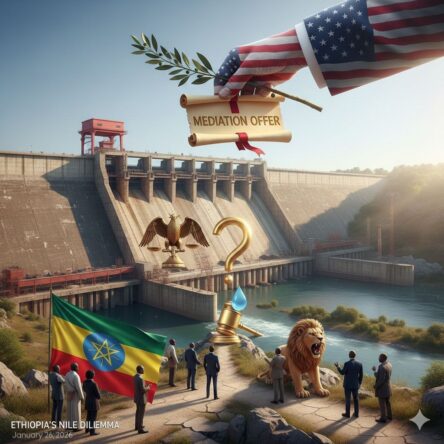
For generations, the Nile was governed by colonial-era agreements favoring downstream powers. Now, Ethiopia has changed the equation. With Africa’s largest dam fully operational… and a new Nile treaty officially in force… the balance of power on the Nile is shifting for the first time in modern history.
The two decisive developments, the Grand Ethiopian Renaissance Dam (GERD) reaching full operational status and the Cooperative Framework Agreement (CFA) entering into force with the Nile River Basin Commission (NRBC) established have already happened. Cairo’s long-standing efforts diplomatic isolation, international lobbying, appeals to colonial-era treaties, and implied pressure could not prevent these outcomes. Ethiopia has altered the facts on the ground and the legal-political framework.
The Grand Ethiopian Renaissance Dam (GERD) stands as one of the most audacious infrastructure projects of the 21st century. Completed and inaugurated in September 2025, it symbolizes Ethiopia’s engineering victory, a testament to national ambition, technical ingenuity, and resilience against formidable odds. Complementing this is a quieter but equally significant diplomatic victory: the entry into force of the Cooperative Framework Agreement (CFA) and the establishment of the Nile River Basin Commission (NRBC). Together, these achievements mark a pivotal shift in the governance of the world’s longest river, empowering upstream nations while challenging long-standing downstream dominance.
Construction of the GERD began in 2011 on the Blue Nile, about 30 km upstream from the Sudanese border in the Benishangul-Gumuz region. Ethiopia funded domestically through bonds and public contributions, bypassing international financing often influenced by downstream concerns. By late 2025, the dam reached full operational status, with multiple turbines online and capacity ramping toward 6,450 MW.
The scale is staggering. The main roller-compacted concrete (RCC) gravity dam rises 145 meters high and stretches 1,780 meters across, with a structural volume exceeding 10 million cubic meters, the largest RCC gravity dam in Africa. Its reservoir holds up to 74 billion cubic meters of water, covering about 1,874 square kilometers at full capacity. During construction, engineers set a world record by placing 23,000 cubic meters of RCC in a single 24-hour period.
The benefits for Ethiopia are transformative. The dam will roughly double the country’s electricity generation, addressing chronic power shortages and enabling exports to neighbors. It promises flood control, improved water management, and economic growth through reliable energy for industry and households. For a nation striving for middle-income status, GERD is more than infrastructure; it is a beacon of self-reliance and modernization. Prime Minister Abiy Ahmed and Ethiopian leaders have hailed it as a symbol of African ingenuity and sovereignty over natural resources.
Critics, particularly in Egypt, raised alarms over potential reductions in downstream flows, evaporation losses, and impacts during drought. However, studies and Ethiopia’s operational stance emphasize that the GERD is a run-of-the-river hydropower project designed for power generation rather than large-scale irrigation consumption. Coordinated filling and operation could even mitigate floods and provide benefits across the basin, though trust-building remains essential.
Parallel to the engineering feat runs a diplomatic success that redefines Nile hydro-politics. For decades, the 1929 and 1959 Nile Waters Agreements allocating the vast majority of waters to Egypt and Sudan governed the basin under colonial legacies that largely ignored upstream rights. Upstream states, including Ethiopia which contributes ~85% of the Nile’s water via the Blue Nile, long sought equitable utilization.
The Nile Basin Initiative (NBI), launched in 1999, fostered technical cooperation among 10 riparian states. Its crowning achievement was the Cooperative Framework Agreement (CFA), opened for signature in 2010. The CFA emphasizes equitable and reasonable utilization, “water security” for all states, benefit-sharing, and sustainable development. It rejects unilateral vetoes and prioritizes contribution to the river’s flow and drainage area as key factors.
After years of delays, the CFA entered into force on October 13, 2024, following ratifications by six states (Ethiopia, Rwanda, Tanzania, Uganda, Burundi, and South Sudan). This triggered the transition from the NBI to the permanent Nile River Basin Commission (NRBC). The Commission provides a robust institutional framework for dispute resolution, joint projects, data sharing, and coordinated management tasks it must now tackle, including lingering GERD operational issues within defined timelines.
This represents a profound diplomatic victory for Ethiopia and other upstream nations. It formalizes a shift from historical inequities toward modern international water law
principles, as embodied in the 1997 UN Watercourses Convention. While Egypt and Sudan have not joined and continue to voice concerns, the CFA’s legal reality strengthens multilateralism. It diminishes the leverage of bilateral colonial-era treaties and creates a platform where Ethiopia’s GERD can be discussed as part of basin-wide cooperation rather than unilateral provocation.
Ethiopia’s dual victories engineering through GERD and diplomatic through the CFA/NRBC signal a rebalanced Nile Basin. The dam delivers tangible development gains, while the Commission offers a pathway for rules-based governance. Challenges persist: ongoing tensions, climate variability, population pressures, and the need for trust. Yet, with the dam operational and a permanent basin body established, opportunities for win-win outcomes energy exports, joint flood/drought management, and shared prosperity have never been greater.
As Africa confronts energy poverty and climate challenges, Ethiopia’s story inspires. It demonstrates that determined nations can achieve monumental feats through ingenuity and persistence. The GERD lights homes and powers dreams; the CFA and Commission illuminate a more equitable future for the Nile’s 300+ million dependents. The river that once divided may yet unite the region in cooperative development