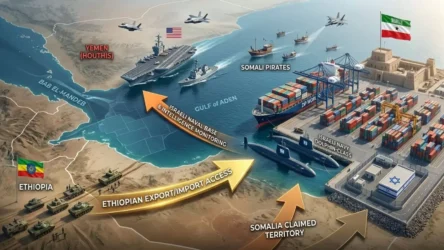
In early 2024, Ethiopia and Somaliland signed a Memorandum of Understanding (MoU) that granted landlocked Ethiopia access to the Red Sea through a leased coastal area near Berbera, in exchange for Ethiopia’s potential future recognition of Somaliland’s independence. The deal, whose full text remained largely confidential, sent immediate shockwaves across the Horn of Africa. While it was later moderated through Turkish mediation that produced a separate understanding between Ethiopia and Somalia, the MoU marked a clear escalation in long-standing frictions between Djibouti and Somaliland.
Strategic and Economic StakesDjibouti’s economy depends heavily on its ports and logistics infrastructure, which handle the bulk of Ethiopia’s import and export trade and generate substantial revenue. The prospect of Ethiopia diverting significant cargo volumes to Somaliland’s UAE-developed Berbera port threatened this model. Beyond economics, Djibouti hosts multiple foreign military bases and has long enjoyed a near-monopoly as a stable Red Sea hub.
Any alternative Ethiopian corridor through Somaliland risked diluting that strategic value and isolating Djibouti’s Issa-dominated heartland from regional trade routes.Somaliland, for its part, viewed the MoU as a major diplomatic breakthrough. After more than three decades of de facto independence without formal recognition, an agreement with Africa’s second-most populous country offered both economic opportunity and a potential pathway toward broader international legitimacy.Immediate Regional BacklashSomalia’s federal government condemned the MoU as a violation of its sovereignty and territorial integrity, arguing that Somaliland remains an integral part of Somalia.
Djibouti aligned closely with this position. Although public statements from Djibouti were often measured, regional analysts and Somaliland officials reported private concern and subsequent actions aimed at protecting Djibouti’s interests.The MoU intensified clan and territorial sensitivities in Somaliland’s western Awdal region, which borders Djibouti and contains the historic port town of Zeila. Communities in Awdal have longstanding cross-border kinship ties, particularly among the Issa clan that forms the political core of Djibouti.
Somaliland authorities accused Djibouti of exploiting these ties by hosting or training Issa and Gadabuursi elements to foment unrest and challenge Hargeisa’s control. Djibouti has consistently denied such allegations, framing its posture as support for regional stability and Somalia’s unity.Escalation on the Ground and DiplomaticallyIn the months following the MoU, tensions manifested in several ways. Somaliland suspended certain sand exports from the Salal region to Djibouti, citing licensing requirements, in a move widely seen as retaliatory.
Djibouti was accused of hosting members of the Awdal State Movement, a group seeking greater autonomy or closer ties to Somalia’s federal structures. Clashes and protests in Zeila and surrounding areas became more frequent, often blending local grievances with broader geopolitical narratives.By late 2025 and into 2026, the atmosphere had further deteriorated. After Israel’s recognition of Somaliland in December 2025, Djibouti closed Somaliland’s liaison office, revoked large numbers of Djiboutian passports held by Somaliland officials and elders, and saw reciprocal steps including the recall of Somaliland’s representative and a ban on Air Djibouti flights.
Armed incidents near the border, including a Somaliland military operation in the Zeila district in January 2026 against a group some sources claimed had crossed from Djibouti, kept the frontier volatile. In August 2026, Somaliland’s Interior Minister publicly accused Djibouti (alongside Somalia and Turkey) of external interference that was prolonging conflict in Awdal and Salal.Broader Context and RisksThe 2024 MoU did not create the underlying disputes historical border ambiguities, clan dynamics, and economic rivalry predated it but it acted as a catalyst.
It highlighted the zero-sum perceptions that dominate the Horn: gains for Somaliland’s international standing or Ethiopia’s sea access were widely viewed in Djibouti as direct losses. Infrastructure projects, such as road upgrades linking Djibouti to Zeila and Borama, became politicized as potential vehicles for influence rather than purely developmental initiatives.As of mid-2026, open interstate conflict has been avoided. Traditional mediation and government-led peace efforts continue in western Somaliland, and ordinary cross-border movement has not ceased.
Yet the combination of unresolved recognition politics, competition for Red Sea basing and port traffic, and the involvement of external powers (Turkey, the UAE, Israel, China, and others) keeps the border area a pressure point. Localized violence can escalate quickly when external actors are perceived to be involved.The 2024 MoU illustrated how a bilateral economic and political arrangement can rapidly reshape regional alignments and amplify existing fault lines.
For Djibouti and Somaliland, the episode reinforced mutual distrust one side sees existential economic and strategic threats; the other sees interference designed to block its path to recognition and development. Managing these tensions will require pragmatic engagement that separates legitimate security concerns from zero-sum competition an outcome that remains elusive amid the broader contests playing out along the Red Sea.