

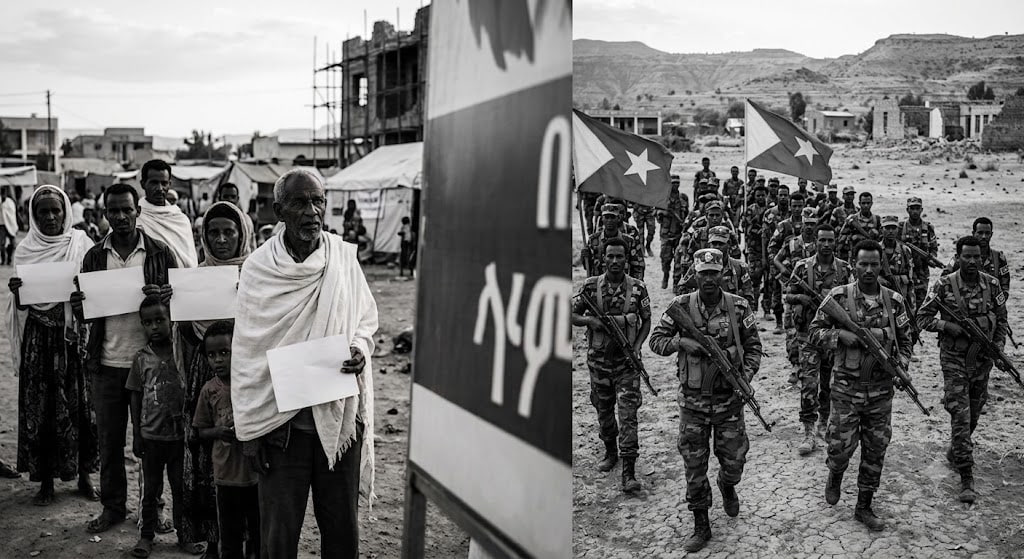
The struggle over Tigray’s future is increasingly a struggle over competing visions of power. While TPLF hardliners present themselves as the guardians of Tigrayan interests, their actions have often prioritized preserving party dominance, ideological continuity, and political leverage over post-war recovery. The debate is no longer only about representation, but whether elite survival has come at the cost of peace, reconstruction, and the long-term welfare of ordinary Tigrayans.
The hardliners within the Tigray People’s Liberation Front (TPLF) primarily the faction around chairman Debretsion Gebremichael, Fetlework Gebregziabher, and allied veterans are not primarily “about the Tigray people.” They are about retaining organizational power, ideological continuity from the party’s revolutionary-democratic roots, territorial minimalism, and elite survival, often at the expense of ordinary Tigrayans’ immediate welfare, recovery, and long-term security. The TPLF originated in the 1970s as an ethnic-nationalist guerrilla movement responding to real historical marginalization of Tigrayans within the Ethiopian state. For decades it dominated national politics through the EPRDF coalition and delivered developmental gains in Tigray while imposing a highly centralized, authoritarian party structure. That history gives it residual legitimacy among some Tigrayans as the institutional vehicle of group interests. Hardliners lean on this narrative: they accuse conciliatory figures (such as former interim leader Getachew Reda) of betraying core Tigrayan demands return of disputed western territories, resettlement of hundreds of thousands of displaced people, and meaningful autonomy. They frame tighter party control and resistance to full implementation of the 2022 Pretoria Agreement as necessary protection of the people. Yet the record after the devastating 2020–2022 war shows a different priority ranking. Tigray suffered catastrophic loss of life, infrastructure destruction, famine risk, and mass displacement. Reconstruction, demobilization, humanitarian access, and economic recovery became existential needs for civilians. Hardliners systematically undermined the interim administration that was trying to operationalize the ceasefire, sidelined moderates, reasserted party dominance over regional structures, and slowed or obstructed disarmament and reintegration. They have aligned opportunistically with former adversaries (including elements linked to Eritrea) when it served internal power struggles.
US visa restrictions in 2026 explicitly targeted “hardline” TPLF figures for actions risking relapse into large-scale violence. Independent reporting and analysis describe the faction as treating political monopoly as the precondition for “protecting TPLF interests,” even when that stance collides with widespread civilian preference for peace and rebuilding.
This is classic elite behavior in ethno-nationalist movements that win power or fight for it. The party apparatus, its security networks, its veterans’ networks, and its ideological self-image become ends in themselves. Ordinary people become the rhetorical justification and, when necessary, the resource base young men for mobilization, legitimacy for external diplomacy, and a captive population whose suffering can be instrumentalized. Criticisms from within Tigray itself former leaders, civil society voices, and ordinary residents exhausted by cycles of war—repeatedly describe hardliners as holding the population hostage to unresolved maximalist demands and internal score-settling. The same pattern appeared during the war: decisions that prolonged fighting or complicated relief efforts were framed as defense of the people while imposing enormous costs on them.
None of this denies genuine Tigrayan grievances. Ethnic federalism’s logic encourages every group’s elites to maximize group claims. Hardliners exploit real unfinished business. But being about the people would require subordinating party survival and prestige to measurable civilian outcomes stable security, economic revival, reduced militarization, and political pluralism inside Tigray. The hardline track record prioritizes the opposite: restoring the pre-war political order, testing the federal government’s resolve through brinkmanship, and treating compromise as existential threat to the organization. Comparative cases are instructive. Liberation fronts that transition successfully eventually professionalize governance, accept pluralism, and measure success by citizen welfare rather than monopoly control. But Tigray’s hardliners have so far chosen the wrong path. Their rhetoric remains nationalist and people-centered; their actions reveal a narrower calculus of power retention and ideological fidelity. When those two diverge, the people absorb the costs renewed displacement risk, delayed recovery, and the constant shadow of another round of fighting. An honest assessment therefore rejects the claim that hardliners simply embody the Tigrayan interest. They embody a particular elite faction’s interest in remaining the indispensable interlocutor and dominant force. Tigrayans as a people have diverse preferences; many prioritize ending the cycle of devastation over maximalist territorial or political victories that keep the region militarized. Treating the hardliners as synonymous with the people flattens that diversity and excuses elite self-preservation dressed up as collective destiny. Sustainable progress for Tigray requires the opposite: institutions and leaders willing to trade some organizational power for civilian recovery and a workable political settlement. The hardline faction has shown limited appetite for that trade-off.