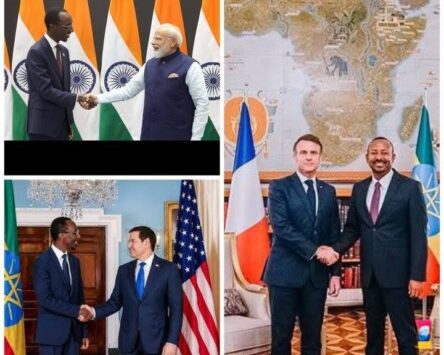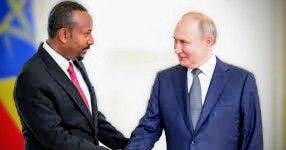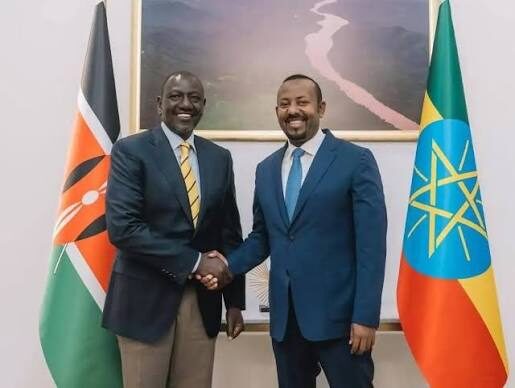
In the shifting currents of global power, Africa faces a defining choice: which international structure best serves its long-term interests? The recent appearances of Ethiopian Prime Minister Abiy Ahmed as a full member at the BRICS Summit in New Delhi and Kenyan President William Ruto as an invited guest at the G7 Summit in Évian, France, offer a clear answer.
Neither BRICS nor the G7 alone is sufficient. Africa’s future depends on strategic, simultaneous engagement with both and the East African giants, Ethiopia and Kenya, are uniquely positioned to lead that dual advocacy.BRICS, expanded to include Ethiopia since 2024, represents the rising voice of the Global South. As a full member, Ethiopia sits at the table where decisions on alternative finance, multipolar governance, and South-South cooperation are shaped. Abiy’s participation in New Delhi underscored this: discussions on resilience, critical minerals, debt predictability, and climate-linked development give African nations institutional weight they lack elsewhere.
BRICS offers continuity ongoing summits, potential access to the New Development Bank, and collective bargaining power against Western-dominated institutions. For a continent seeking to escape perpetual guest status, full membership provides dignity and leverage.Yet the G7, for all its exclusivity, remains indispensable Ruto’s invitation to the French-hosted summit in June 2026 allowed Kenya to press for reforms to the global financial architecture, cheaper capital, debt transparency, and a reframing of Africa as a partner rather than a perpetual recipient of aid.
The G7 controls vast pools of investment, technology, and markets that Africa still needs. Outreach sessions may be temporary, but they open doors to Partnership for Global Infrastructure, Global Gateway initiatives, and private capital that BRICS cannot yet match in scale Ignoring this forum would mean forgoing tools essential for industrialization and job creation.The long-term structure that serves Africa is therefore not a binary choice but a complementary one.
Exclusive alignment with BRICS risks isolation from advanced-economy capital and technology. Exclusive reliance on G7 invitations leaves Africa permanently peripheral, dependent on the goodwill of hosts. A multipolar strategy full membership where available, assertive outreach where invited maximizes options. Africa can extract better terms by playing both fields: using BRICS solidarity to demand reform while using G7 platforms to secure concrete financing and partnerships.
This is where Ethiopia and Kenya, the Horn and East African giants, become indispensable. Ethiopia brings demographic weight, strategic location astride the Red Sea and Nile Basin, and now formal BRICS membership. Its voice carries institutional legitimacy inside the bloc, allowing it to push for African priorities on debt, resources, and climate. Kenya, with its dynamic economy, regional hub status, professional security forces, and proven diplomatic agility, excels at bridge-building.
Ruto’s ability to co-host the Africa Forward Summit with France and then carry that agenda into the G7 demonstrates how Kenya can translate continental consensus into Western forums Together, these two nations form a powerful East African axis. Ethiopia can ensure BRICS remains attentive to African realities rather than dominated by larger members. Kenya can keep African concerns visible in G7 deliberations, preventing the continent from being sidelined.
Their coordination sharing intelligence on negotiations, aligning positions on financial reform, and jointly advocating value addition for critical minerals and renewable energy would amplify the African voice far beyond what either could achieve alone.History shows the cost of disunity Fragmented African diplomacy has too often allowed external powers to dictate terms.
A coordinated approach by Ethiopia and Kenya, rooted in Agenda 2063 and the African Continental Free Trade Area, can change that calculus. They can insist that any engagement whether South-South or North-South delivers technology transfer, local processing of resources, fair debt restructuring, and genuine partnership.Long-term, Africa does not need to choose between East and West, BRICS and G7.
It needs both structures working in its favor. Ethiopia’s membership provides permanence and multipolar ballast. Kenya’s outreach provides access and pragmatic results. When these two giants speak in concert inside BRICS halls and G7 outreach sessions, they force the world to listen. The continent’s interests are best served not by exclusive clubs, but by skilled navigation of multiple tables.
Ethiopia and Kenya have already taken their seats. The task now is to ensure that Africa’s voice, amplified by these East African leaders, shapes the rules rather than merely reacting to them.In a multipolar world, the smartest strategy is engagement without subordination. For Africa, that path runs through both BRICS and the G7 and the Horn giants are the ones best placed to walk it.