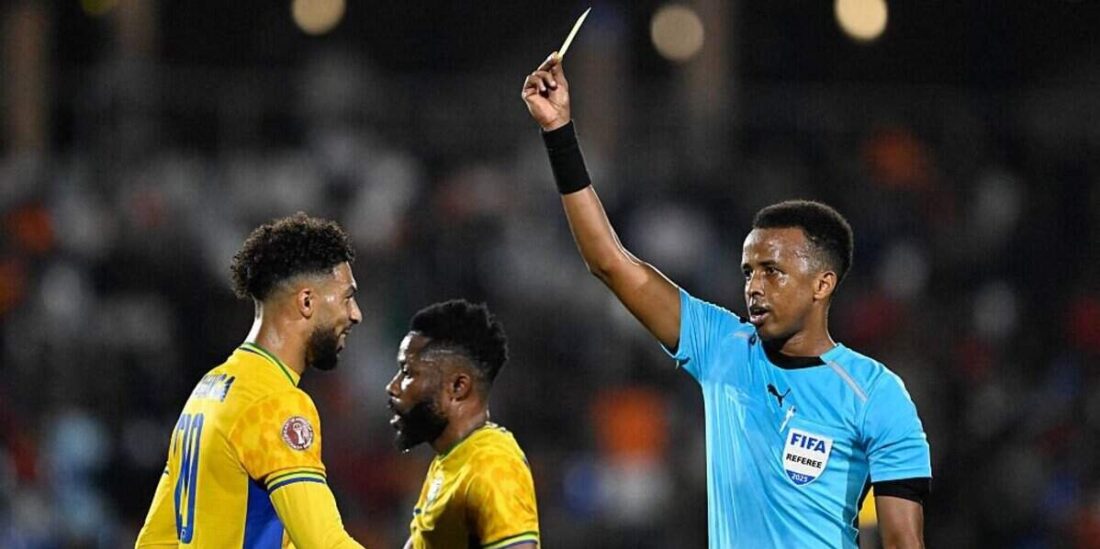
A historic moment for Somali football has ended in controversy before a single whistle was blown.
Omar Abdulkadir Artan, the first Somali referee ever selected by FIFA to officiate at a FIFA World Cup, has been denied entry into the United States and subsequently removed from the tournament’s officiating roster. The decision has sparked disappointment across Somalia, reignited debate over U.S. immigration policies, and raised broader questions about the challenges of hosting a global sporting event amid stringent border security measures.
Artan’s exclusion is not merely a personal setback. For many Somalis, it represents the loss of a rare opportunity for positive international recognition at a time when the country continues to struggle against decades of conflict and instability.
According to U.S. Customs and Border Protection, Artan arrived at Miami International Airport from Istanbul on June 6. After undergoing what officials described as additional inspection, he was determined to be inadmissible due to unspecified “vetting concerns” and was denied entry into the United States. Authorities have not publicly disclosed the precise reasons behind the decision.
What makes the incident particularly striking is that Artan reportedly possessed a valid U.S. visa and had already been cleared to travel for World Cup duties. FIFA had included him among the selected match officials for the 2026 tournament, while Somali officials stated that all required documentation had been secured before his departure.
The 34-year-old referee is no ordinary official. In 2025, he was named the Confederation of African Football’s Referee of the Year, becoming one of the continent’s most respected football officials. He has officiated major African competitions, including CAF Champions League matches and the Africa Cup of Nations. His World Cup appointment was widely celebrated as a milestone not only for Somali football but also for the country’s broader efforts to rebuild its international image through sport.
However, after being denied entry, Artan was forced to return to Istanbul, where he had been based. FIFA subsequently confirmed that he would be unable to participate in World Cup preparations, training sessions, or tournament matches. As a result, his historic debut as the first Somali referee at a World Cup will not happen.
The case unfolds against the backdrop of increasingly restrictive U.S. immigration measures.
Somalia remains among the countries affected by enhanced screening procedures and broader travel restrictions implemented under current U.S. policies. While possessing a visa generally allows a traveler to seek entry into the United States, final admission remains the responsibility of border authorities, who can deny entry if concerns emerge during inspection. U.S. officials have emphasized that all travelers, including athletes, coaches, and tournament personnel, are subject to the same admissibility review process.
Yet critics argue that the decision exposes a tension between national security policies and the realities of hosting global sporting events. The FIFA World Cup is designed to bring together participants from virtually every region of the world, including countries facing diplomatic disputes, sanctions, or travel restrictions.
Artan’s case demonstrates how those two realities can collide. Despite FIFA’s selection process and the issuance of travel documentation, immigration authorities ultimately exercised their sovereign authority to refuse entry.
The reaction in Somalia has been swift.
Sports officials, former players, and government representatives have described the decision as deeply disappointing. Somalia’s Ministry of Youth and Sports has reportedly begun seeking explanations through diplomatic channels, arguing that Artan’s appointment was a source of national pride and an important symbol of Somalia’s growing presence in international sport.
Many observers note that Artan’s journey carried significance beyond football. Somalia has rarely been associated with global sporting success. His selection by FIFA was viewed as evidence that Somali professionals could compete and excel at the highest international level despite the country’s difficult circumstances.
Within football circles, concerns have also emerged regarding the precedent such incidents could create. Some analysts question whether future tournaments hosted in countries with restrictive immigration policies could face similar controversies involving players, officials, journalists, or support staff from affected nations. Community discussions online have likewise raised questions about whether alternative arrangements could have been considered given that the tournament is jointly hosted by the United States, Canada, and Mexico.
FIFA, however, has maintained that immigration decisions are entirely the responsibility of host governments. The organization confirmed Artan’s removal from the officiating roster but emphasized that it does not control visa approvals or border admission procedures.
Beyond the immediate controversy, the incident highlights a challenge that may continue throughout the tournament.
The 2026 FIFA World Cup is the largest in history, involving 48 national teams, thousands of athletes and officials, and participants from nearly every political and geographic context. Managing security concerns while preserving the tournament’s universal character will remain a delicate balancing act for host governments.
For Somalia, however, the story is more personal.A referee who had spent years climbing the ranks of African football, earned FIFA’s trust, and prepared to make history on the sport’s biggest stage now finds himself watching from the sidelines.
For Omar Abdulkadir Artan, the dream of becoming the first Somali referee at a FIFA World Cup has been postponed, perhaps indefinitely.
For Somalia, what should have been a moment of celebration has become a diplomatic and sporting controversy.
And for the United States, the episode serves as an early reminder that hosting a global event is not only about stadiums, logistics, and security it is also about managing the intersection of national policy and international expectations.