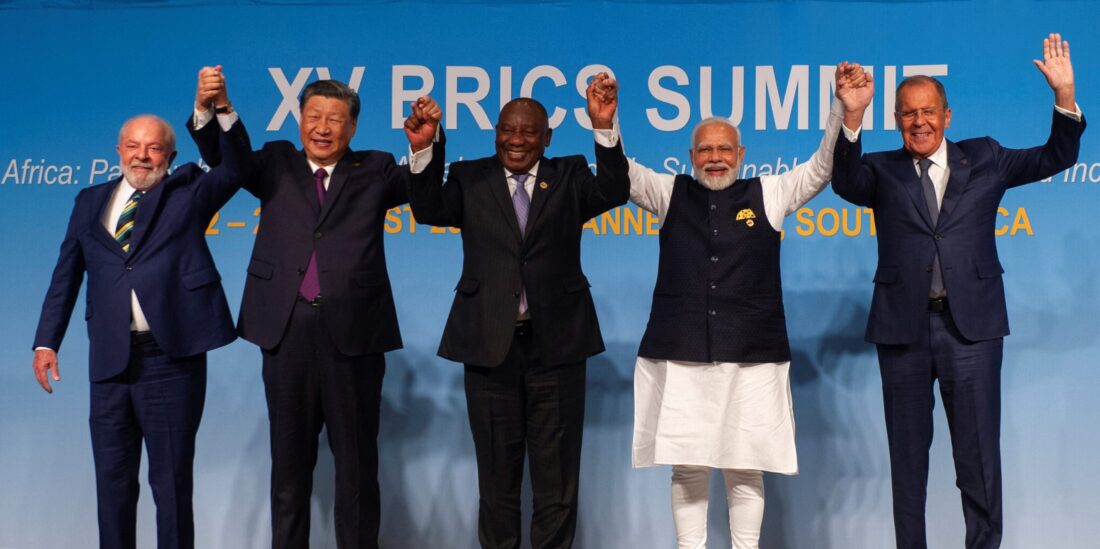
A BRICS member has been under attack for months and has subsequently wielded attacks of its own against fellow members This coming weekend, those countries will all be in the same room, making a third attempt to find consensus on a war that has dominated global attention and battered economies this year.
India hosts the BRICS Leaders’ Summit from Saturday, seeking to raise the bloc’s profile even as the United States-led war on Iran exposes divisions among its members, with Tehran and Abu Dhabi on opposing sides. Russian President Vladimir Putin landed in New Delhi on Friday morning the September 12-13 summit in New Delhi comes more than six months after the US and Israel launched attacks on Iran, which has been a BRICS member since 2024. The United Arab Emirates also joined that year.
The grouping of emerging countries Brazil, Russia, India, China, South Africa, and in more recent years Iran, the UAE, Saudi Arabia, Egypt, Ethiopia and Indonesia was created to challenge the Western-led order Yet as the alliance nears its 20-year anniversary, analysts say that while BRICS has helped make the world more multipolar, it has struggled to build a coherent alternative to the West.
The bloc has created a platform outside Western-led institutions, giving Global South countries greater bargaining power and economic alternatives. But the dollar remains dominant, and divisions limit collective action on foreign policy and security, say analysts However, some experts argue that the success of BRICS should not be measured by whether it can pose an alternative to West-led institutions, but by whether it makes Western dominance harder to exercise.
“We tend to undermine any BRICS-led initiative as it is not the revolution we have expected,” said Brazilian researchers Octavio Oliveira and Enzo Godinho at the BRICS Studies Group at the University of Sao Paulo, in an emailed statement to Al Jazeera “Yes, it does not have the institutionality or the capacity of the UN to tackle specific geopolitical issues, but its mere existence is a much more important platform for Global South countries to express their voices and bypass the West in cooperation.”
The bloc emerged after the 2008 financial collapse and the failures of the World Trade Organization’s (WTO) Doha Round trade negotiations that aimed to reform the international trading system in favour of Global South countries “Countries that were spearheaded to become the next ‘developed’ nations understood that their voice would be best heard if they organised themselves as a group,” said Oliveira and Godinho.
BRICS emerged from these countries’ efforts to pursue a common development agenda outside traditional international organisations and the United Nations and, in that sense, its very origins challenged the Western-led order, the Brazilian scholars said Emerging powers wanted greater influence over institutions they felt were dominated by the West. And that’s a major priority still uniting the group today, says Sean Burges, an associate professor of international studies at Canada’s Carleton University.
“The two priorities uniting the BRICS countries are largely a desire to make lots of money through international trade and to see an end to the preachiness of the ‘West’ about where they are failing in terms of rights and democracy,” Burges told Al Jazeera The analysts agreed that reform and greater autonomy have been far greater concerns for the BRICS bloc rather than overthrowing the unravelling liberal international order.
“Why would the BRICS want to take on the global governance responsibilities of the G7 members?” asked Burges.
BRICS has offered its member countries alternative pathways for channelling trade and investment that serve the interests of the member countries largely national development and poverty alleviation, he explained “Chinese concentration on development assistance without conditionality and Brazilian discussions of direct central bank currency swaps are two of the most obvious examples,” said Burges.