

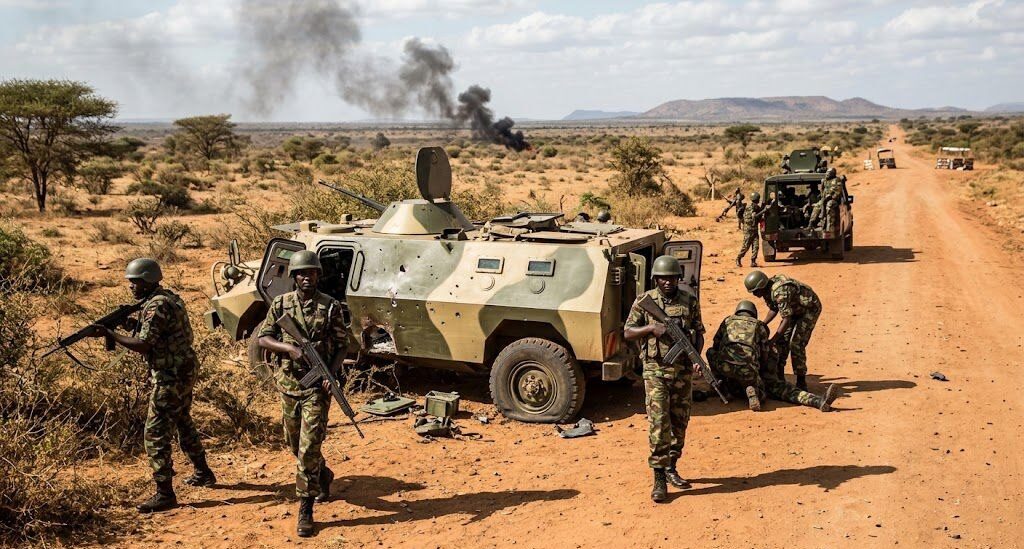
Eleven Al-Shabaab militants are dead after Kenyan security forces struck a militant camp near the Somalia border in Mandera. The operation stopped a planned attack. But the bigger story is what happened next: within weeks, militants were back on the offensive, killing Kenyan security personnel and exposing the limits of a purely reactive border strategy.
On July 12, Kenyan security forces launched an intelligence-led operation against an Al-Shabaab makeshift camp near the Kenya-Somalia border in Mandera County. The Special Operations Group, supported by aerial assets, targeted about 30 militants who Kenyan authorities said were preparing an attack on a border village.
Eleven militants were killed, seven were seriously wounded, and others escaped across the border into Somalia. Three PKM machine guns, around 409 rounds of ammunition and documents linked to Al-Shabaab were recovered The raid was presented as a successful pre-emptive operation. But the subsequent pattern of violence suggests a more complicated security picture.
The Mandera operation demonstrated the value of intelligence-led counterterrorism. Kenyan forces detected a militant concentration before the planned attack reached its target. That matters in a region where Al-Shabaab has repeatedly exploited the porous Kenya-Somalia frontier to move fighters, weapons and supplies.
The recovery of alleged Al-Shabaab tax receipts is also significant. Kenyan authorities said the documents offered insight into the group’s taxation and checkpoint systems. This points to a threat that is not simply a collection of mobile fighters. Al-Shabaab continues to maintain financial and administrative mechanisms in areas where it exercises influence.
Yet killing 11 fighters does not dismantle that infrastructure. The remaining militants fled into Somalia, where they can regroup, recruit and potentially return across the border.
The subsequent events make that limitation clearer On July 28, suspected Al-Shabaab militants ambushed a Kenyan patrol near Wantey Dam in Mandera. Five security officers were killed after their vehicle reportedly struck an improvised explosive device and came under gunfire. A reinforcement team was also hit by another IED, destroying an armoured vehicle.
The sequence matters. The July 12 raid disrupted an attack. Sixteen days later, militants demonstrated that their operational capacity remained intact the violence continued into August. Kenyan forces reported repelling another suspected Al-Shabaab attack near Konton in Wajir on August 22. Five Mandera herders were also abducted near the border in late August before local elders helped secure their release.
This shows that the threat extends beyond spectacular terrorist attacks. It includes IEDs, ambushes, abductions and pressure on local communities Mandera is strategically important because geography works both ways. The county sits directly beside Somalia, while local communities and economic networks operate across a border that is difficult to seal completely.
For Kenya, insecurity in Mandera affects more than public safety. It threatens roads, local commerce, security deployments and confidence in borderland economic activity. Repeated attacks can also force authorities to concentrate resources in remote areas, increasing the cost of maintaining security.
For Al-Shabaab, the objective does not necessarily require holding Kenyan territory. Disrupting movement, intimidating communities and forcing security forces into expensive defensive deployments can achieve strategic effects with relatively limited manpower that is why the group’s ability to absorb tactical losses remains important.
The central challenge is that Kenya cannot fully solve the Mandera problem inside Kenya alone the militants who escaped the July operation crossed back into Somalia. This underlines the structural problem created by the border. Kenyan forces can conduct raids and strengthen surveillance, but militant sanctuaries, recruitment networks and financial structures on the Somali side remain part of the threat environment.
The problem also intersects with Somalia’s wider security transition. As Somali forces attempt to assume greater responsibility for security, Al-Shabaab continues to exploit gaps in state authority. Pressure on the group in Somalia can produce displacement effects, including increased attempts to infiltrate neighbouring Kenya.
This makes Kenya’s border security inseparable from Somalia’s internal security trajectory.
The regional implication is also important. Kenya’s security posture affects the wider Horn because Mandera connects the security environments of Somalia, Ethiopia and Kenya. Sustained militant pressure can disrupt commerce and regional mobility, while intensified Kenyan operations can push networks toward other vulnerable corridors and place greater pressure on communities.
So, was the Mandera raid a success? Tactically, yes. Eleven suspected militants were killed, a planned attack was disrupted, and weapons and intelligence material were recovered.
Strategically, the picture is less reassuring the attacks that followed show that Al-Shabaab retains the ability to regenerate, cross the frontier and shift tactics from planned assaults to IEDs, ambushes and abductions For Kenya, the lesson is clear. Intelligence-led raids can prevent immediate attacks, but durable security will require sustained border surveillance, community intelligence, disruption of militant financing and stronger coordination with Somali security structures Mandera is therefore not simply a story about eleven militants killed. It is a test of whether Kenya can turn tactical counterterrorism successes into lasting control of its most vulnerable frontier.




Nice one.